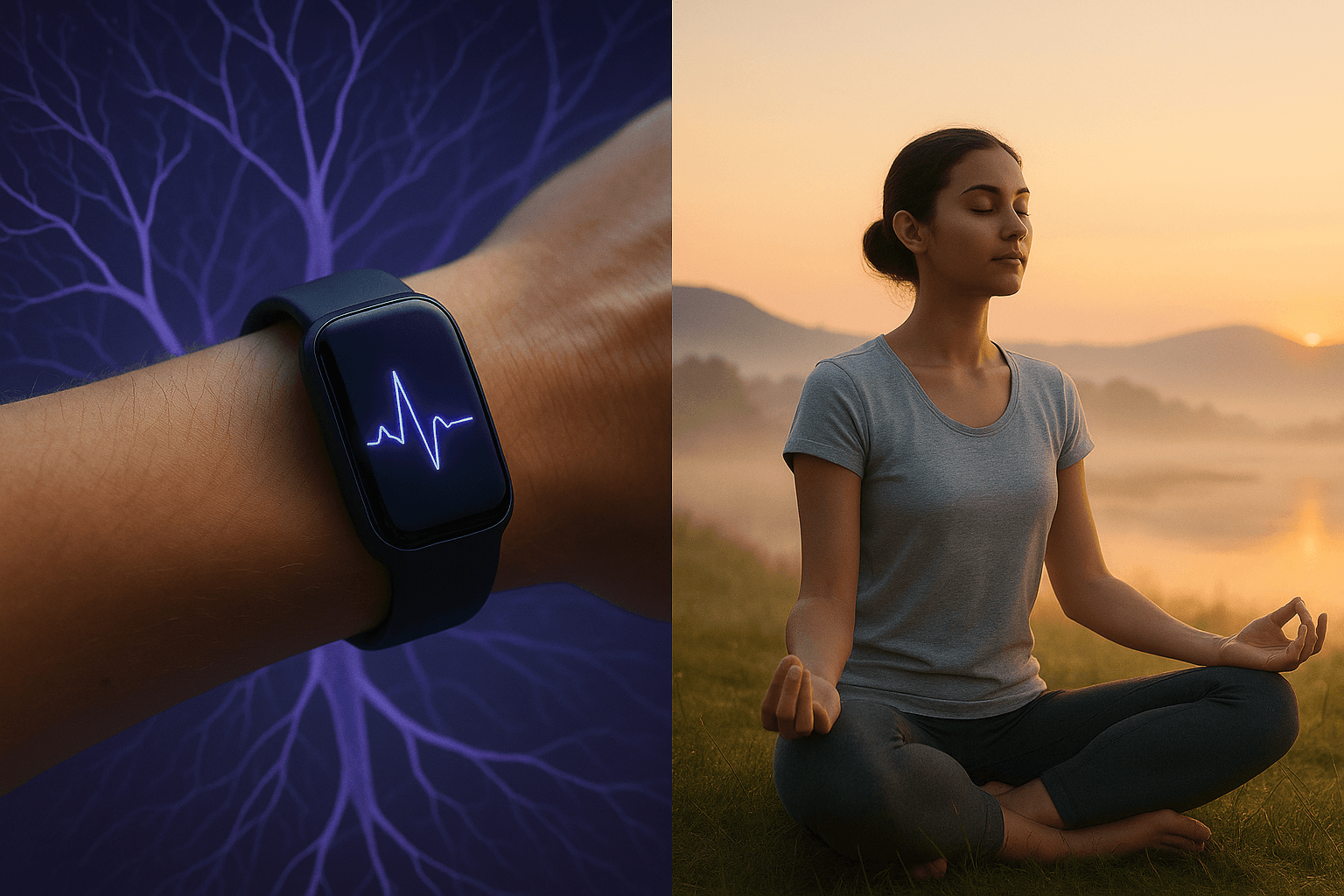
Your heart isn't a metronome. And honestly? That's the best news you'll get today.
If you've ever glanced at your Oura Ring or WHOOP band and seen a number labeled "HRV" — then immediately Googled "what is HRV" while pretending you totally already knew — welcome. You're in the right place. Heart rate variability is quietly becoming the single most important health metric tracked by wearables, and most people wearing $300+ devices on their wrists have no idea what it actually means.
Here's the thing: HRV isn't just another number. It's a real-time window into your autonomic nervous system — the invisible control center running digestion, stress responses, recovery, immune function, and sleep quality behind the scenes. Understanding HRV meaning at a practical level can change how you eat, train, meditate, sleep, and manage stress. No exaggeration.
This guide will walk you through everything: what heart rate variability actually is (in plain language), how it's measured, what normal HRV ranges look like by age and gender, what destroys it, what improves it, how your wearable tracks it, and — critically — why a single HRV number sitting in a single app is a massive missed opportunity.
Let's get into it.
⚡ Key Takeaways (TL;DR)
- HRV measures the variation in time between heartbeats. Higher is generally better — it signals your nervous system is flexible and resilient.
- Your autonomic nervous system has two branches: sympathetic (fight-or-flight) and parasympathetic (rest-and-digest). HRV reflects the balance between them.
- Normal HRV ranges vary dramatically by age, gender, fitness level, and genetics. Comparing your HRV to someone else's is mostly useless — track your own trends.
- Alcohol, poor sleep, chronic stress, overtraining, and dehydration are the top HRV destroyers. Consistent sleep, meditation, moderate exercise, and nutrition are the top improvers.
- Wearables like Oura and WHOOP measure HRV differently (time of measurement, sensor placement, algorithms), which is why your numbers won't match across devices.
- A single HRV number in a single app is a missed opportunity. When HRV data flows into your meditation, nutrition, yoga, and daily planning, it becomes genuinely actionable.
What Is HRV? Heart Rate Variability Explained in Plain English
Let's start with the counterintuitive part.
You'd think a perfectly healthy heart would beat with clock-like regularity. Beat. Beat. Beat. Evenly spaced, like a drum machine. But that's actually a sign of trouble.
A healthy heart is irregular — intentionally so. If your heart rate is 60 BPM, that doesn't mean one beat every exactly 1.000 seconds. One interval might be 0.87 seconds, the next 1.04 seconds, the next 0.92 seconds. These tiny variations — measured in milliseconds — are your heart rate variability.
Heart rate variability (HRV) is the measurement of the variation in time intervals between consecutive heartbeats. Those intervals are called R-R intervals (or inter-beat intervals), named after the R-wave peaks on an ECG readout.
Why does this matter? Because those micro-fluctuations aren't random noise. They're controlled signals from your autonomic nervous system (ANS) — and they reveal how well your body adapts to the world around it.
Think of HRV as your body's adaptability score. A high HRV means your nervous system is flexible, responsive, and ready to handle whatever you throw at it — a tough workout, a stressful meeting, a bad night of sleep. A low HRV means your system is rigid, stressed, or depleted. It's still functioning, but it's running on fumes.
HRV vs. Heart Rate: They're Not the Same Thing
This trips people up constantly. Heart rate tells you how fast your heart is beating. HRV tells you how rhythmically it's beating. You can have a resting heart rate of 58 BPM with either a high or low HRV.
A marathon runner and a chronically stressed office worker might both show 62 BPM at rest. But the runner's HRV might be 85ms while the office worker's is 28ms. Same heart rate. Vastly different stories about what's happening under the hood.
The Autonomic Nervous System: Why Your Body Has Two Gears
To really understand what HRV means, you need a quick tour of the system that controls it.
Your autonomic nervous system (ANS) is the part of your nervous system that runs on autopilot. You don't consciously decide to digest lunch, dilate your pupils, or increase your heart rate when you sprint for a bus. The ANS handles all of it.
It has two main branches:
The Sympathetic Nervous System (SNS) — "Fight or Flight"
This is your gas pedal. When you're stressed, scared, exercising, or chugging espresso, your sympathetic system ramps up. It increases heart rate, redirects blood to muscles, suppresses digestion, and narrows the variation between heartbeats.
Result: lower HRV.
This isn't inherently bad — you need sympathetic activation to perform, compete, and respond to genuine threats. The problem is when your gas pedal gets stuck.
The Parasympathetic Nervous System (PNS) — "Rest and Digest"
This is your brake pedal. Mediated primarily through the vagus nerve (the longest cranial nerve in your body, running from your brainstem to your abdomen), the parasympathetic system slows your heart rate, promotes digestion, enables recovery, and increases the variation between heartbeats.
Result: higher HRV.
The vagus nerve is the star of the HRV story. When it's toned and responsive (high "vagal tone"), your HRV is higher. This is why practices that stimulate vagal tone — deep breathing, meditation, cold exposure — tend to improve HRV over time.
The Balance Is Everything
Healthy humans oscillate between sympathetic and parasympathetic dominance throughout the day. You fire up SNS during your morning workout, shift to PNS during lunch, maybe spike SNS during an afternoon meeting, then settle into PNS as you wind down for sleep.
HRV captures this dance in a single metric. High HRV = smooth transitions between gears. Low HRV = stuck in one gear (usually sympathetic), grinding.
How HRV Is Measured: RMSSD, Time-Domain, and the Metrics That Matter
If you've ever dived into your wearable's advanced settings, you've probably seen acronyms like RMSSD, SDNN, or pNN50 and immediately closed the screen. Fair. But here's the quick version — because knowing how your HRV number is calculated helps you understand what it actually tells you.
Time-Domain Metrics
These are the most common HRV measurements, and they're based on the statistical analysis of the time intervals between heartbeats.
| Metric | What It Measures | What It Reflects | Used By |
|---|---|---|---|
| RMSSD | Root Mean Square of Successive Differences between heartbeats | Short-term, beat-to-beat variability; parasympathetic activity | Oura, WHOOP, most consumer wearables |
| SDNN | Standard Deviation of all Normal-to-Normal intervals | Overall HRV including both SNS and PNS input | Clinical studies, some wearables |
| pNN50 | Percentage of successive intervals differing by >50ms | Parasympathetic activity | Clinical research |
RMSSD is the gold standard for consumer wearables. When your Oura Ring or WHOOP band shows you an HRV number, it's almost certainly RMSSD (measured in milliseconds). It's the most reliable short-term HRV measurement and specifically reflects parasympathetic (vagal) activity.
Why RMSSD? Because it's relatively resistant to artifacts and noise, and it can produce meaningful readings from short recording windows (as little as 60 seconds under controlled conditions, though 5+ minutes during sleep is far more reliable). For consumer wearables doing overnight measurements, RMSSD is the sweet spot of accuracy and practicality.
Frequency-Domain Metrics (For the Curious)
Researchers also analyze HRV in the frequency domain — breaking the heart rhythm signal into different frequency bands using mathematical transformations:
- HF (High Frequency, 0.15–0.4 Hz): Primarily reflects parasympathetic activity. Correlated with RMSSD.
- LF (Low Frequency, 0.04–0.15 Hz): Reflects a mix of sympathetic and parasympathetic activity. More debate here.
- LF/HF Ratio: Once thought to represent sympathetic/parasympathetic balance. Now considered oversimplified by most researchers.
Most consumer wearables stick to time-domain (RMSSD) for good reason: it's simpler, more robust, and perfectly adequate for daily health tracking. You don't need frequency-domain analysis to make smart decisions about your day.
What's a Good HRV Score? Normal Ranges by Age, Gender, and Fitness
This is the question everyone asks. And the honest answer is: it depends.
HRV varies enormously based on age, biological sex, fitness level, genetics, and measurement conditions. Comparing your HRV to a friend's is about as useful as comparing shoe sizes to predict running speed.
That said, here are general population ranges to give you a frame of reference. These are approximate RMSSD values measured during sleep or at rest:
| Age Range | Average Female RMSSD (ms) | Average Male RMSSD (ms) |
|---|---|---|
| 20–25 | 40–80 | 45–90 |
| 25–35 | 35–70 | 40–80 |
| 35–45 | 30–60 | 35–70 |
| 45–55 | 25–50 | 28–55 |
| 55–65 | 20–40 | 22–45 |
| 65+ | 15–30 | 18–35 |
Sources: Population studies including Nunan et al. (2010), Koenig & Thayer (2016), and aggregated data from Oura and WHOOP published research. Ranges are approximate and reflect nighttime/resting RMSSD.
Key Context for These Numbers
HRV naturally declines with age. This is normal. A 55-year-old with an HRV of 35ms might be in excellent shape, while a 25-year-old with the same number might need to investigate their lifestyle.
Women tend to have slightly lower RMSSD than men on average, though this gap narrows after menopause. Hormonal cycles also influence HRV — many women notice lower HRV in the luteal phase (post-ovulation) and higher HRV in the follicular phase.
Elite athletes often have HRV scores of 80–150+ ms, which can look abnormally high to clinical baselines. Endurance training in particular increases vagal tone dramatically.
Your personal baseline matters more than any population average. This is the single most important thing to understand about HRV tracking. If your baseline is 45ms and it drops to 28ms after a bad week, that's significant — regardless of whether 45ms is "above average" for your age group.
Find Your HRV Range
Interactive HRV Range Chart
Enter your details to see personalized HRV ranges based on published research
Ranges are estimates based on published RMSSD research aggregates and vary by measurement device (Oura, WHOOP, Garmin, Apple Watch). HRV is highly individual — track your own trend over weeks rather than comparing single readings. This tool is for educational purposes and is not medical advice.
What Destroys HRV (and What Improves It): The Evidence
Here's where HRV gets genuinely useful as a health metric. Because it responds to lifestyle factors within hours to days, it becomes a real-time feedback loop for your choices.
The Top HRV Destroyers
1. Alcohol This is the big one, and it's not subtle. Even moderate alcohol consumption (2–3 drinks) can suppress HRV for 24–72+ hours. A 2018 study in the Journal of Clinical Medicine found that alcohol significantly reduced HRV, particularly RMSSD, during sleep — even at doses most people consider "social drinking." Your Oura score the morning after two glasses of wine isn't lying to you.
2. Poor Sleep Quality Short sleep, fragmented sleep, and inconsistent sleep schedules all tank HRV. Deep sleep (N3) is when your parasympathetic system does its heaviest restoration work. Miss it, and your HRV reflects the deficit. The relationship between HRV and sleep quality is bidirectional — poor sleep lowers HRV, and the resulting sympathetic dominance makes the next night's sleep worse too. It's a vicious cycle.
3. Chronic Psychological Stress Acute stress is fine — your HRV dips, you handle the situation, your HRV recovers. Chronic stress — the kind that comes from job pressure, relationship strain, financial anxiety, caregiving burnout — keeps your sympathetic system perpetually elevated. Over weeks and months, this suppresses baseline HRV and erodes recovery capacity.
4. Overtraining Exercise improves HRV. Overexercise destroys it. When training load consistently exceeds recovery capacity, HRV trends downward. This is actually one of the most practical applications of daily HRV tracking — catching overtraining before it becomes injury or burnout. If your HRV has been declining for 5–7 consecutive days despite adequate sleep, your body is sending a clear signal.
5. Dehydration and Poor Nutrition Your autonomic nervous system is sensitive to hydration status and nutrient availability. Chronic dehydration, ultra-processed diets high in inflammatory ingredients, and nutrient deficiencies (particularly magnesium, omega-3 fatty acids, and B vitamins) are all associated with lower HRV in observational studies.
6. Illness and Infection Your HRV often drops before you feel symptoms of an illness. Several published case studies (and a lot of anecdotal wearable data from the COVID-19 era) showed HRV declining 1–3 days before symptom onset. Your autonomic nervous system detects the immune response before your conscious mind registers a sore throat.
The Top HRV Improvers
1. Consistent, Sufficient Sleep Nothing — and I mean nothing — improves HRV more reliably than sleeping 7–9 hours on a consistent schedule. Going to bed and waking up within a 30-minute window every day (including weekends) has an outsized effect on autonomic stability. If you're only going to do one thing on this list, make it this.
2. Regular Moderate Exercise Aerobic exercise (running, cycling, swimming) at moderate intensity 3–5 times per week is consistently associated with improved HRV in meta-analyses. The key word is moderate. Going too hard too often does the opposite. The dose-response curve is real.
3. Meditation and Breathwork Here's where things get especially interesting. Slow, deep breathing at approximately 6 breaths per minute (known as "resonance frequency breathing") directly stimulates the vagus nerve and has been shown to increase HRV both acutely (during the session) and chronically (over weeks of practice). Vipassana, mindfulness-based meditation, and yoga nidra all show positive effects on HRV in published research.
This isn't mystical — it's mechanical. Slow exhalation activates the parasympathetic system via the vagus nerve. Do it repeatedly, and you're essentially doing reps for your vagal tone.
4. Anti-Inflammatory Nutrition Diets rich in omega-3 fatty acids (fatty fish, walnuts, flaxseed), magnesium (dark leafy greens, pumpkin seeds, dark chocolate), polyphenols (berries, green tea, turmeric), and fermented foods are associated with higher HRV. The Mediterranean diet, in particular, has positive associations with HRV in several studies.
Conversely, diets high in refined sugar, trans fats, and ultra-processed foods are associated with systemic inflammation and lower HRV.
5. Cold Exposure Cold showers, cold plunges, and cold water immersion activate the vagus nerve and trigger parasympathetic responses. The research is still evolving, but several small studies show acute HRV improvements following cold exposure, and regular cold practice may improve baseline HRV over time.
6. Social Connection and Emotional Wellbeing This one gets overlooked in the biohacking community, but it matters. Positive social interactions, laughter, gratitude practices, and emotional safety are all associated with higher vagal tone. Loneliness and social isolation are associated with lower HRV. Humans are social animals, and the autonomic nervous system knows it.
HRV Improvement Factors: At a Glance
| Factor | Effect on HRV | Timeframe to See Change | Strength of Evidence |
|---|---|---|---|
| Consistent sleep schedule | ↑↑↑ Strong increase | 1–2 weeks | Very strong |
| Alcohol elimination | ↑↑↑ Strong increase | 24–72 hours (acute); 2–4 weeks (baseline) | Very strong |
| Regular moderate exercise | ↑↑ Moderate increase | 4–8 weeks | Strong |
| Meditation / breathwork | ↑↑ Moderate increase | 2–6 weeks | Strong |
| Anti-inflammatory diet | ↑ Moderate increase | 4–12 weeks | Moderate |
| Chronic stress reduction | ↑↑ Moderate increase | 2–8 weeks | Strong |
| Cold exposure | ↑ Mild-moderate increase | 2–4 weeks | Emerging |
| Overtraining | ↓↓↓ Strong decrease | Days | Very strong |
| Acute illness | ↓↓↓ Strong decrease | Days | Very strong |
| Dehydration | ↓↓ Moderate decrease | Hours | Moderate |
How Wearables Track HRV: Oura vs. WHOOP (and Why Your Numbers Don't Match)
If you own both an Oura Ring and a WHOOP strap, you've probably noticed something mildly infuriating: they give you different HRV numbers. Sometimes very different. Does that mean one is wrong?
Not exactly. They measure differently, at different times, with different algorithms. Understanding these differences matters — especially if you're trying to use HRV data to make actual decisions.
Oura Ring HRV Tracking
- Sensor type: Infrared photoplethysmography (PPG) from the finger
- When it measures: During sleep only (specifically during your longest period of deep rest)
- What it reports: Average nighttime RMSSD, displayed as your nightly HRV
- Readiness Score: HRV is a major input into Oura's Readiness Score, weighted against your personal baseline
- Strengths: Finger PPG tends to have strong signal quality; nighttime-only measurement reduces noise from daytime activity; Oura's 3-month baseline learning adapts to your personal norms
- Limitations: No daytime HRV; single nightly average can mask variability across sleep stages
WHOOP HRV Tracking
- Sensor type: PPG from the wrist (or bicep with WHOOP Body)
- When it measures: During the last period of slow-wave sleep (SWS) — the deepest sleep phase
- What it reports: RMSSD calculated during SWS, reported as your daily HRV
- Recovery Score: HRV is the primary driver of WHOOP's Recovery metric
- Strengths: Measuring during SWS is arguably the most physiologically controlled window; WHOOP's strain tracking provides workout context
- Limitations: Wrist PPG can have more motion artifacts than finger; if you don't get much SWS, the measurement window is narrow
Why the Numbers Differ
| Factor | Oura | WHOOP |
|---|---|---|
| Sensor location | Finger (palmar artery) | Wrist/bicep |
| Measurement window | Entire sleep period (averaged) | Last slow-wave sleep period |
| Algorithm focus | Broad nighttime average | Peak deep-sleep snapshot |
| Baseline period | ~3 months rolling | ~30 days rolling |
| HRV metric | RMSSD (ms) | RMSSD (ms) |
Because Oura averages across the full night and WHOOP isolates the deepest sleep phase, WHOOP values are often higher than Oura values for the same person on the same night. Neither is "wrong" — they're measuring different slices of the same underlying physiology.
Other wearables like Polar (chest strap, considered near-clinical accuracy), Garmin (wrist PPG with overnight HRV status), and Apple Watch (opportunistic overnight measurements) add even more variability to the picture.
The Real Problem: Fragmented Data, Fragmented Insight
Here's where HRV tracking gets frustrating — and where most people hit a wall.
You get your HRV number. You see it's lower than yesterday. Now what?
Your Oura app might suggest you "take it easy today." Your WHOOP might put you in the yellow recovery zone. But neither app does anything with that information beyond showing you a color-coded score.
Your low HRV doesn't automatically adjust your meditation practice toward calming techniques. It doesn't shift your meal plan toward anti-inflammatory, magnesium-rich foods. It doesn't tell your yoga session to lean into restorative poses instead of power vinyasa. It doesn't nudge your morning routine toward a gentler start.
That HRV number sits in one app, on one screen, in one dashboard. And you — the person who is probably already juggling 4–6 health and wellness apps — are left to manually connect the dots.
This is the fundamental problem with how wearable data works today. The measurement is excellent. The application is almost nonexistent.
Beyond the Dashboard: When HRV Data Actually Does Something
Let's paint a picture of what HRV tracking could look like if your data actually flowed somewhere useful.
Imagine this: you wake up and your overnight HRV is notably lower than your 30-day baseline. Instead of just seeing a yellow score and shrugging, here's what happens:
- Your morning wellness check-in acknowledges that your body seems to need more recovery today — without dumping raw numbers on you. It says something like: "Your body's recovery signals are lower than your usual. Let's go gentle today."
- Your meditation session adapts. Instead of the focused-attention meditation you'd normally get, the AI suggests Yoga Nidra or a slow breathing exercise at 6 breaths per minute — practices specifically shown to improve vagal tone and acute HRV.
- Your nutrition plan shifts. The day's meals emphasize anti-inflammatory foods: salmon, leafy greens, turmeric-spiced dishes, berries. Caffeine recommendation: only before noon, and maybe just one cup instead of three. Hydration target: bumped up.
- Your yoga practice pivots from the Ashtanga flow you had scheduled to a Yin or Restorative session — longer holds, deeper parasympathetic activation.
- Your gym recommendations suggest a rest day, a light walk, or gentle mobility work instead of the HIIT session on your calendar.
Notice what didn't happen: nobody showed you a number and said "your RMSSD is 22ms, which is 34% below your 30-day rolling average." Instead, the data was translated into action across every relevant domain of your day.
This cross-product intelligence — where a single biometric signal like HRV flows into meditation, nutrition, yoga, fitness guidance, and daily planning — is the difference between tracking your health and actually responding to it.
It's also precisely what doesn't exist when your wearable data lives in one app, your meditation in another, your nutrition in a third, your yoga in a fourth, and your therapy in a fifth. The wellness app fatigue is real, but the deeper problem isn't just too many apps — it's that none of them talk to each other.
Sathi.fit's Wearable Insights was built to solve exactly this problem. By connecting 6+ wearable brands — Oura, WHOOP, Strava, Polar, Suunto, and more — into a single unified dashboard, and then flowing that normalized biometric data into every product on the platform (meditation, nutrition, yoga, daily companionship), the HRV number that used to just sit on a screen finally has somewhere meaningful to go.
It's not about replacing your wearable. It's about making the data your wearable collects actually do something across your entire wellness routine.
Frequently Asked Questions About HRV
What is a good HRV score?
There's no single "good" number because HRV varies enormously by age, sex, fitness level, and genetics. For adults aged 25–45, an RMSSD between 35–80ms during sleep is a common range. However, your personal trend matters far more than any absolute number. A consistent HRV of 40ms with small day-to-day variation is a healthier signal than an HRV that swings between 25 and 75ms erratically. Track your own baseline over 2–3 months before drawing conclusions.
Is higher HRV always better?
Generally, yes — a higher HRV indicates greater autonomic flexibility and parasympathetic tone. However, extremely high HRV can occasionally indicate certain cardiac conditions (like some arrhythmias) in clinical contexts. For the vast majority of people tracking HRV with consumer wearables, a trend toward higher HRV is a positive sign.
What causes low HRV?
Common causes include poor or insufficient sleep, alcohol consumption, chronic psychological stress, overtraining, dehydration, acute illness, and inflammatory diets. Low HRV can also be a normal characteristic for older adults or individuals with certain health conditions. If your HRV is consistently declining over weeks without an obvious lifestyle explanation, it's worth discussing with a healthcare provider.
Can you improve HRV?
Yes. The most effective strategies include: consistent sleep of 7–9 hours on a regular schedule, regular moderate aerobic exercise, meditation and slow breathing exercises (especially at ~6 breaths per minute), reducing or eliminating alcohol, eating an anti-inflammatory diet, managing chronic stress, and staying well-hydrated. Most people see measurable improvements within 2–8 weeks of consistent changes.
Why is my Oura HRV different from my WHOOP HRV?
Because they measure at different times, from different body locations, using different algorithms. Oura measures from the finger and averages across the entire sleep period. WHOOP measures from the wrist and focuses on the last deep-sleep phase. WHOOP values are often higher for the same person on the same night. Both are valid — just don't compare them directly. Pick one device as your primary HRV tracker for trend analysis.
Does HRV change during the menstrual cycle?
Yes. Many women experience lower HRV during the luteal phase (the ~2 weeks between ovulation and the start of menstruation) due to hormonal shifts that increase sympathetic nervous system activity. HRV tends to be higher during the follicular phase. This is a normal physiological variation and one reason why cycle-aware wellness tracking matters.
How long should I track HRV before my baseline is reliable?
Most experts and wearable platforms recommend at least 2–4 weeks of consistent tracking to establish a meaningful baseline, and 2–3 months for a robust one. Oura uses a 3-month rolling baseline; WHOOP uses approximately 30 days. Day-to-day fluctuations are normal — it's the multi-week trend that tells the real story.
Can I measure HRV without a wearable?
Yes, but it's less convenient. Chest strap heart rate monitors (like Polar H10) connected to apps like Elite HRV or HRV4Training can measure HRV with near-clinical accuracy. Some smartphone apps claim to measure HRV using the phone's camera and flash (finger on lens), but the accuracy is debatable and not recommended for serious tracking.
What's the relationship between HRV and stress?
HRV and stress have an inverse relationship. Acute stress activates the sympathetic nervous system and temporarily lowers HRV — this is normal. Chronic stress keeps the sympathetic system elevated and suppresses baseline HRV over time. Regular HRV tracking can serve as an early-warning system for accumulated stress before it manifests as burnout, illness, or injury.
Conclusion: Your HRV Deserves Better Than a Dashboard
Heart rate variability is one of the most meaningful health metrics available through consumer technology. It reflects the real-time state of your autonomic nervous system — the invisible infrastructure behind sleep, recovery, stress resilience, immune function, and performance.
And right now, for most people, that metric sits in a single app, on a single screen, doing almost nothing.
The wearable industry has solved the measurement problem brilliantly. Oura, WHOOP, Polar, Garmin — they all capture HRV with impressive accuracy. What hasn't been solved is the application problem: taking that data and weaving it into the decisions you actually make every day about how to breathe, eat, move, rest, and recover.
That's the gap. Not another HRV tracker. Not another dashboard with prettier graphs. But a connected wellness platform where your biometric data — HRV included — actually influences every part of your routine.
Maybe there's a better way to do this.
Explore how Sathi.fit connects your wearable data to everything →
This article is for educational purposes only and is not intended as medical advice. If you have concerns about your heart rate variability, cardiovascular health, or any health condition, please consult a qualified healthcare professional.
See what happens when your wearable data stops sitting in a dashboard and starts powering your entire wellness routine.
Get Started Free